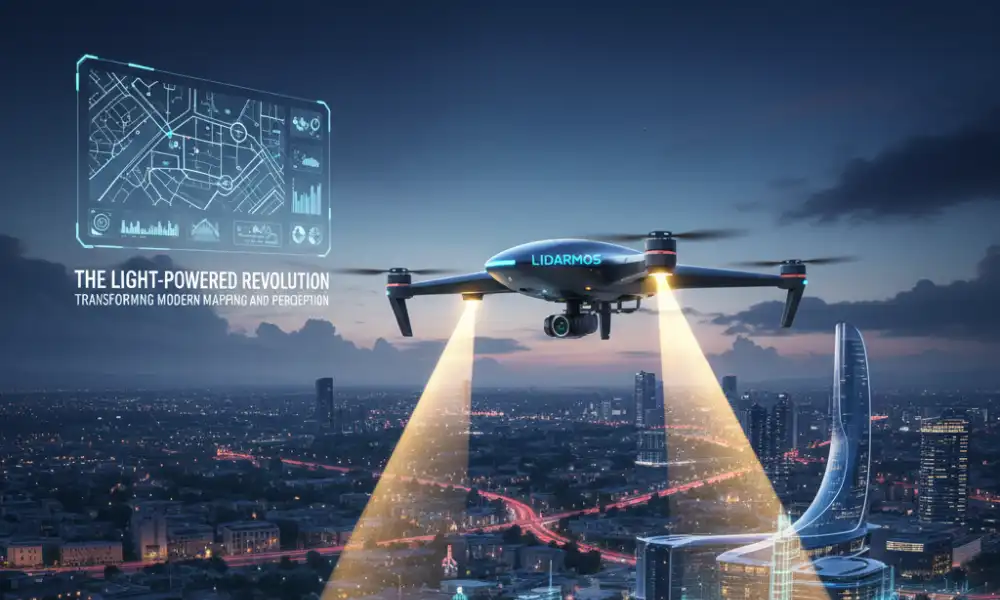
Technology has always moved humanity forward—but every few decades, a discovery appears that doesn’t just improve how we live; it reshapes how we see the world. One such breakthrough is Lidarmos, a cutting-edge concept that merges precision, data, and light to reveal the invisible dimensions around us.
While the name “Lidarmos” may sound futuristic, its roots lie in one of the most powerful innovations of our time—LiDAR technology. But Lidarmos isn’t just LiDAR reborn; it’s LiDAR evolved—smarter, faster, and more adaptive than anything that came before it.
What Exactly Is Lidarmos?
At its core, Lidarmos can be understood as an advanced evolution of Light Detection and Ranging (LiDAR). It uses laser pulses to map environments in astonishing detail, but it goes beyond traditional LiDAR by combining AI-driven analytics, sensor fusion, and real-time processing.
In simple terms, Lidarmos doesn’t just scan an environment—it understands it. Imagine a device that emits beams of light, calculates how long they take to bounce back, and creates a living 3D map of everything around it. Now imagine that system infused with artificial intelligence that interprets what it sees, classifies objects, and learns over time.
That’s Lidarmos—a digital eye for the physical world.
Check Out Other related articles
- Lidarmos: The Light-Powered Revolution Transforming Modern Mapping and Perception
- Närkes Elektriska: Powering the Future with Innovation and Sustainability
- Premiumindo69 – The Future of Online Gaming, Entertainment, and Community Engagement
- Kalibraatio: The Hidden Science of Precision That Powers Every Industry
- Sylveer: The Modern Symbol of Creativity, Growth, and Digital Evolution
The Science Behind Lidarmos
To appreciate Lidarmos, it helps to understand how it works beneath the surface. Traditional LiDAR systems measure distances by sending out laser pulses and timing their reflections. Lidarmos builds upon this by introducing multi-spectral scanning and adaptive frequency modulation, allowing it to capture surfaces with varying reflectivity—like glass, water, or mist—without losing accuracy.
But the real magic lies in its data interpretation layer. Once the raw spatial data is collected, Lidarmos uses machine learning algorithms to detect patterns, identify shapes, and even predict movement. In a self-driving car, for instance, Lidarmos can not only see a pedestrian crossing the road but also anticipate their trajectory.
This fusion of physics and AI turns static mapping into dynamic awareness, enabling machines to react faster and smarter than ever before.
Lidarmos in Real-World Applications
The impact of Lidarmos reaches far beyond robotics. From space exploration to smart cities, its applications are expanding daily.
- Autonomous Vehicles:
Self-driving cars rely heavily on spatial perception, and Lidarmos gives them eyes that never blink. Its enhanced precision allows vehicles to detect obstacles hundreds of meters away, even in rain or fog, improving safety and navigation. - Environmental Monitoring:
Lidarmos systems are being deployed to track deforestation, glacier retreat, and ocean depth changes. By capturing micro-level terrain data, they provide scientists with real-time environmental intelligence. - Urban Planning:
In modern cities, planners use Lidarmos data to design smarter infrastructure—everything from drainage systems to traffic flow optimization. It brings an unprecedented level of detail to digital city models. - Cultural Heritage Preservation:
Archaeologists use Lidarmos scans to digitally preserve ancient ruins and artifacts, capturing their geometry down to the millimeter—without touching a single stone. - Agriculture and Forestry:
Lidarmos sensors mounted on drones can analyze crop growth patterns, detect pest infestations, and even estimate carbon storage in forests.
These examples show that Lidarmos is not just a tool—it’s a universal language of spatial intelligence.
Why Lidarmos Is the Future of Spatial Technology
The world we live in is three-dimensional, but for decades, our digital tools treated it as two-dimensional. Lidarmos changes that by giving machines the ability to see depth as naturally as humans do.
Traditional sensors struggle with reflective or transparent materials, poor lighting, or fast-moving scenes. Lidarmos overcomes these hurdles using adaptive laser modulation and predictive modeling. It doesn’t just record the world—it learns from it.
In industries like logistics, defense, and manufacturing, this means fewer errors, faster decisions, and safer automation. In consumer tech, it promises smarter AR/VR experiences and more intuitive human-machine interaction.
Some experts even call Lidarmos “the nervous system of the digital twin revolution,” because it supplies the real-world data that fuels virtual replicas of factories, cities, and even entire ecosystems.
The Human Side of Lidarmos
Beyond technology, Lidarmos represents a shift in perspective—how we perceive the relationship between humans, data, and the environment. It gives us the ability to see what cannot be seen—from underground pipelines to airborne particles.
Imagine an architect walking through a construction site while a Lidarmos headset visualizes hidden electrical wiring. Or a rescue team entering a collapsed building, guided by a 3D map generated seconds earlier. These aren’t futuristic dreams—they’re already happening in pilot projects around the world.
But there’s also an ethical side. As machines become more perceptive, data responsibility becomes crucial. Lidarmos developers emphasize transparency, encryption, and human oversight to ensure this powerful vision technology is used for good, not surveillance or control.
Challenges and the Road Ahead
Of course, no innovation comes without hurdles. Lidarmos faces challenges in cost reduction, miniaturization, and data processing speed. The sheer amount of data generated by continuous 3D scanning requires immense storage and computing power.
Yet, advancements in edge computing and quantum photonics are addressing these bottlenecks. Within a few years, we may see Lidarmos units the size of a smartphone, capable of mapping entire environments instantly.
The global race for LiDAR supremacy has already begun—but Lidarmos stands out because it focuses not just on seeing better but on understanding deeper. It’s not just evolution; it’s revolution.
Conclusion: Lidarmos and the New Age of Digital Vision
As technology continues to blur the line between the physical and digital worlds, Lidarmos stands as a symbol of what’s next. It’s the eyes of the future—powerful, precise, and profoundly intelligent.
From helping self-driving cars navigate safely to revealing ancient landscapes buried beneath forests, Lidarmos is rewriting how humanity interacts with its surroundings.
In a sense, it’s teaching machines to do something deeply human—to observe, interpret, and adapt. That’s why the rise of Lidarmos isn’t just about better sensors—it’s about a new way of seeing reality itself.
The light that once guided explorers through the darkness now powers the next great leap in human understanding. And that light belongs to Lidarmos.